A parcel or less-than-truckload audit turns on freight class, dimensional weight and accessorial tariffs. A load of chips, stone or grain has none of those. It has a scale ticket, a rate per ton or per load, a fuel surcharge and sometimes waiting time, and those are what this list covers. "Carrier" here means whoever hauled the load and sent the freight bill: a hauler, a trucking company or an owner-operator.
The checklist
Is it a bill, and is it new
- It is an invoice, addressed to you. A statement lists invoices you already have. A credit memo takes money off one. Neither is paid as a bill.
- The invoice number is not already on file for this carrier. Compare without dashes, spaces or leading zeros. Then look for the same carrier, date, amount and ticket number under a different invoice number.
Does the paperwork describe one load
- The ticket number is the one the invoice quotes. Or the bill of lading, order or load number, if that is what both carry.
- The ticket date fits the ship date. Same day or the next.
- Gross minus tare equals net, and pounds agree with tons. Do the subtraction; do not trust the printed net.
- The billed quantity is the weight you agreed to pay on. Origin or destination, as your terms say.
- If there are two tickets, they are close. A legal truck scale may be off by about 0.2% of the load, so a small gap is expected. Several percent on one load means a wrong ticket. See why two truck scales give different weights.
Is the money right
- The rate is the agreed rate for the lane. From your rate sheet or the rate confirmation, not from memory. If all you have is last month's invoices, compare with those and write the rate down.
- Quantity times rate gives the linehaul. To the cent, allowing for tons rounded to two places.
- The fuel surcharge follows the schedule you agreed. See the section below.
- Every extra charge is one you agreed to, and the paperwork supports it. Detention or stand-by time should fit the times on the ticket and any free time in your terms.
- The lines add up to the amount due. Then note the terms and the due date.
Items 3 to 7 are covered step by step, with a spreadsheet layout, in how to reconcile scale tickets against a hauler's invoice.
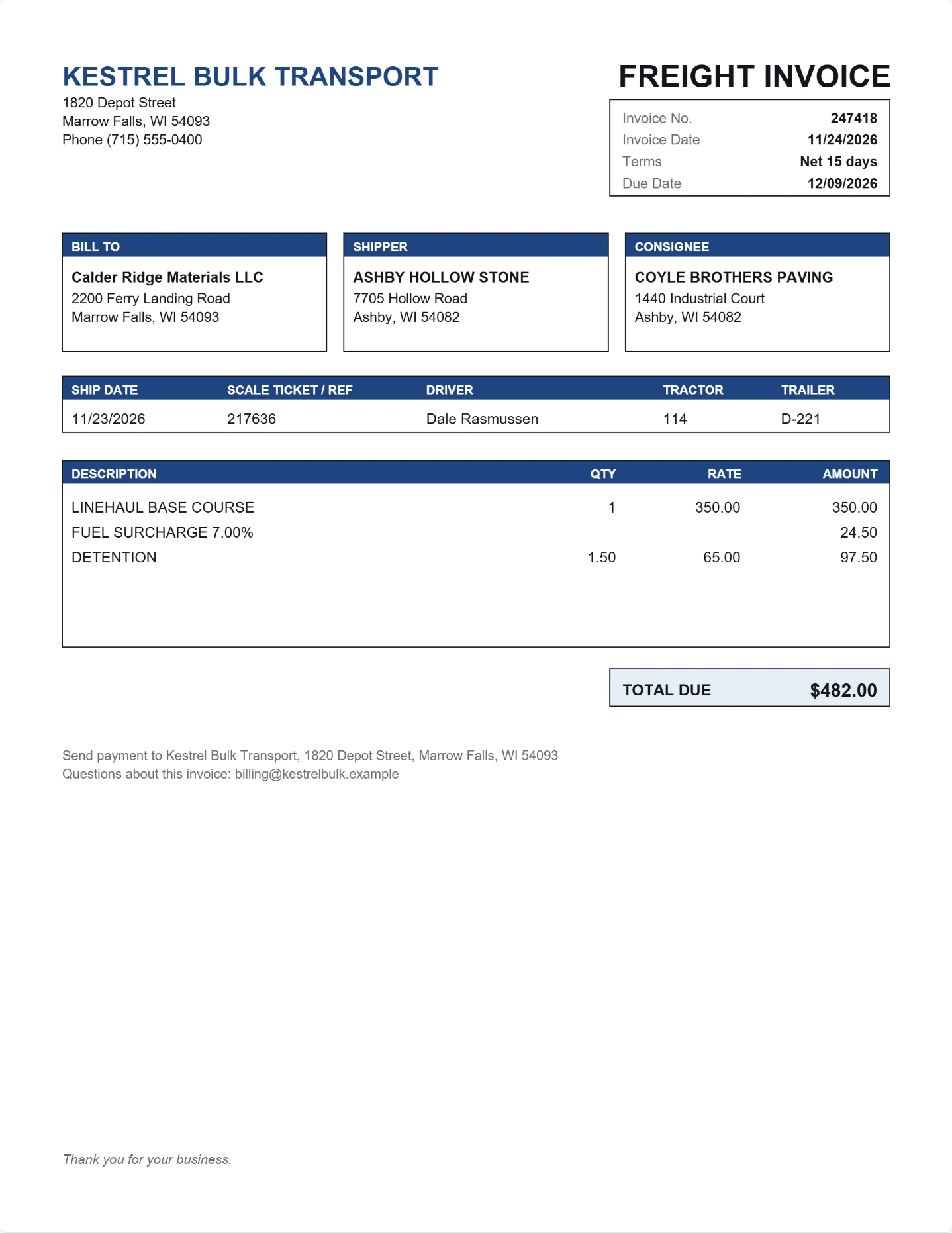
Why the duplicate check comes second
A resent invoice looks exactly like an unpaid one, and nothing on the page tells you it has been paid. It can only be caught by looking it up. When the city auditor of Richmond, Virginia screened two years of payments, 237,261 invoices, the office confirmed 50 duplicate payments totalling $5.76 million. One wire of about $5.09 million, paid twice, was 98% of that. Among the causes the report lists are duplicate vendor records and invoice numbers entered inconsistently. That is one city government and not a freight figure. It is here because the mechanism is the same in any payables office.
The fuel surcharge
Nobody checks this for you. The U.S. Energy Information Administration, which publishes weekly diesel prices, says so directly: "Fuel surcharges are negotiated privately by shippers and by transportation companies" and "EIA does not calculate, assess, or regulate diesel fuel surcharges." EIA updates its on-highway diesel prices every Tuesday.
To check a surcharge you need three things in writing:
- The base it applies to. If that is linehaul only, make sure it is not being taken on detention as well.
- The schedule: the base fuel price, and how much the surcharge moves for each step above it.
- Which published price and which week counts: the week of the haul or the week of the invoice.
If you have no schedule, you have nothing to audit against. Until you agree one, track the surcharge as a percentage of linehaul for each carrier by month, and ask when it moves and diesel has not.
A worked example
Invented figures
The invoice: 22.40 tons at $18.25 a ton, linehaul $408.80. Fuel surcharge 8%, $32.70. Detention 1.5 hours at $75.00, $112.50. Amount due $563.00.
Your terms: $18.25 a ton on delivered weight. Fuel at 1% of linehaul for every 10 cents the published diesel price is above $3.00. One hour free at the plant, then $75.00 an hour.
- Rate: $18.25. Agreed.
- 22.40 times $18.25 is $408.80. Correct.
- Fuel: diesel was $3.80 that week, 80 cents over the base, so 8%. 8% of $408.80 is $32.70. Correct.
- Detention: the delivered ticket shows time in 10:40 and time out 11:05. Twenty-five minutes, inside the free hour. Not supported.
- Total: $408.80 plus $32.70 plus $112.50 is $554.00, not $563.00. The total is $9.00 over its own lines.
What is payable on the paperwork is $441.50, linehaul and fuel. Hold the invoice, send the carrier the two findings with the ticket, and ask for a corrected bill.
What to do with what you find
| Finding | Do this |
|---|---|
| Duplicate invoice | Hold the second copy. Confirm the first was paid, then tell the carrier the check or payment date |
| Wrong or missing ticket | Ask for the right ticket before paying. Do not pay a per-ton bill on a weight you cannot see |
| Arithmetic error on the invoice | Ask for a corrected invoice. Paying a figure you worked out yourself leaves the two sets of books apart |
| Rate above what was agreed | Pay the agreed rate, say so on the remittance, and ask whether an increase was sent that you missed |
| Fuel surcharge off schedule | Send the schedule and the week's price with your figure |
| Unsupported extra charge | Ask for the support: ticket times, or a signed note from the site |
A signature on a ticket is weaker support than it looks. An inspector general's audit of a Chicago city hauling program found that all 1,294 tickets reviewed were signed, but only 5.2% of the signatures matched the list of people authorized to sign. Times, weights and ticket numbers can be checked against something. A scrawl usually cannot.
How long you have: the 180-day rule
Federal law sets a clock. Under 49 U.S.C. 13710(a)(3)(B), a shipper "must contest the original bill or subsequent bill within 180 days of receipt of the bill in order to have the right to contest such charges." The same section gives a carrier 180 days to bill additional charges. So keep the date each invoice arrived, not only the date printed on it.
In practice the useful deadline is much earlier: the day you pay. Holding an invoice costs a phone call. Getting money back from a carrier you still need next week costs more than that. This is not legal advice; for a disputed bill of any size, read the statute and your contract.
What this checklist does not cover
- Parcel and LTL: freight class, dimensional weight, reweighs, residential and liftgate fees.
- Auditing against a full contract tariff. That is the work of a freight audit firm, and worth it at a different size of freight budget.
- Loss and damage claims, which follow their own rules and deadlines.
Sources
- 49 U.S.C. 13710, Additional billing and collecting practices: the 180-day periods.
- U.S. Energy Information Administration, FAQ on diesel fuel surcharges: surcharges are private and unregulated; weekly diesel prices.
- City of Richmond, Office of the City Auditor, report 2026-09, Continuous Monitoring: Duplicate Payments: one city's payments for fiscal years 2024 and 2025.
- City of Chicago Office of Inspector General, Material Truck Haul Program Audit, 2013: one hauling program, tickets from July 2011.
- NIST Weights and Measures newsletter, November 2006: truck scale accuracy of approximately 0.2%.
Loadoc runs these checks on each invoice as it arrives. What it does, and what it does not, is on the freight invoice audit page.