Freight invoice audit
Audit every freight bill before it is paid, not after.
Most of what goes wrong on a hauler's invoice is small and dull: a total that is ten dollars more than its lines, the same invoice sent again a week later, a flat rate that crept above what was agreed. Loadoc checks each bill for those as it arrives.
It is freight audit software sized for a small business that ships truckload and bulk freight. It is not built for parcel or LTL, and it is not an audit and payment service.
What is checked
The invoice, against its own arithmetic and its own paperwork
None of this needs your contracts loaded or a rate table kept up to date. The checks use what is printed on the invoice and what came with it. The examples use made-up figures.
| The check | What you see |
|---|---|
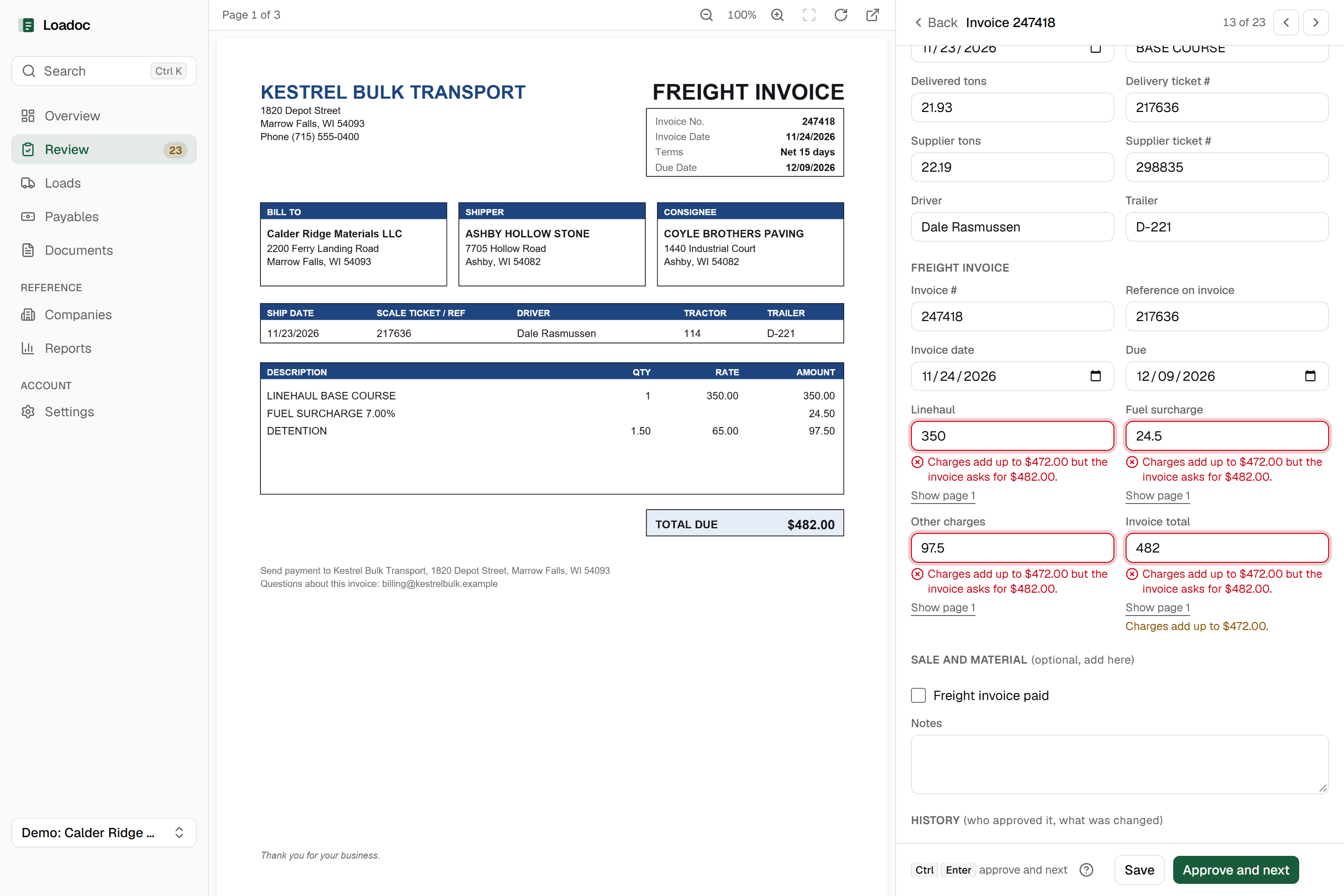
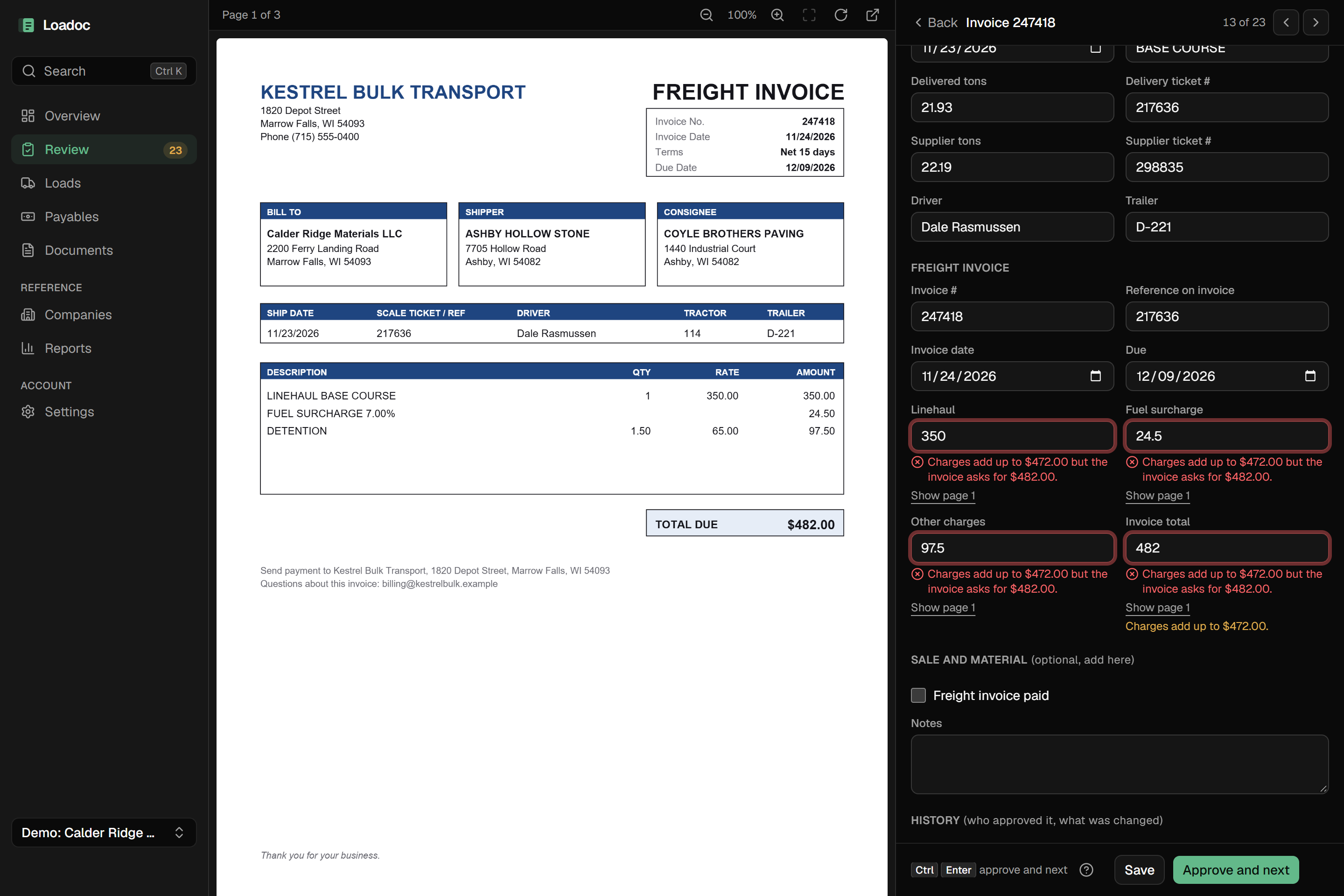
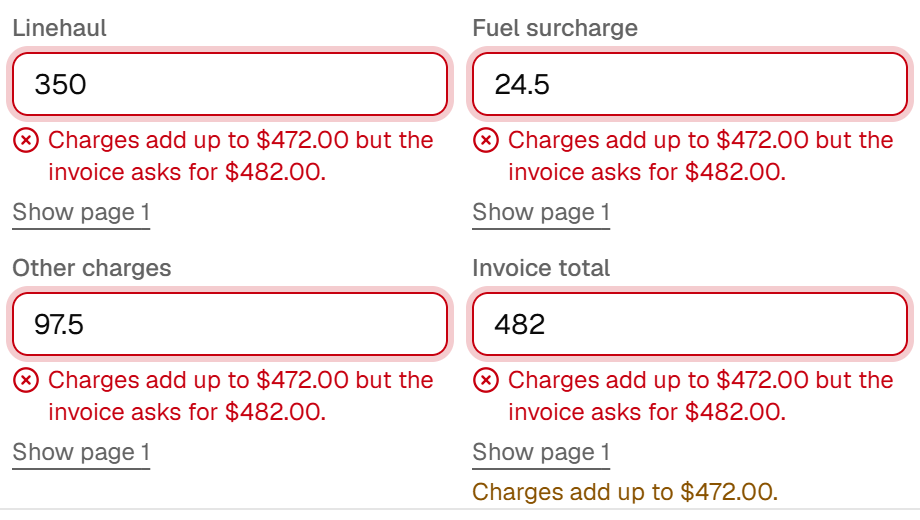
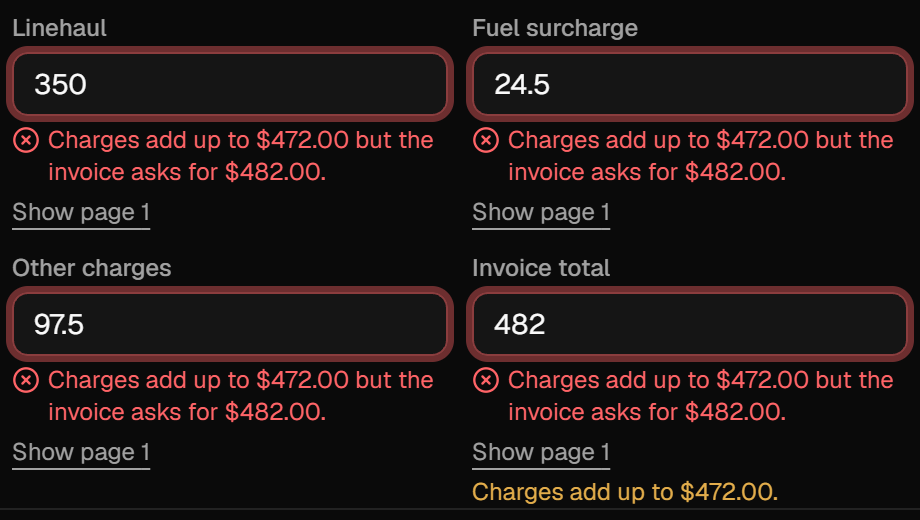
| Charges add up to the totalLinehaul, fuel surcharge and every other charge, added and compared with the amount due. | Flagged: Charges add up to $472.00 but the invoice asks for $482.00. |
| Quantity times rate gives the chargeOn a line that prints tons or miles and a rate. Allows a dollar or half a percent for rounding. | Flagged: Quantity times rate does not give the charge. 23.22 tons at $29.07 is $675.01, not $975.01. |
| The total matches the rate confirmationWhen the rate confirmation is in the same PDF. | Flagged: Rate confirmation says $670.00 but the invoice asks for $691.00. |
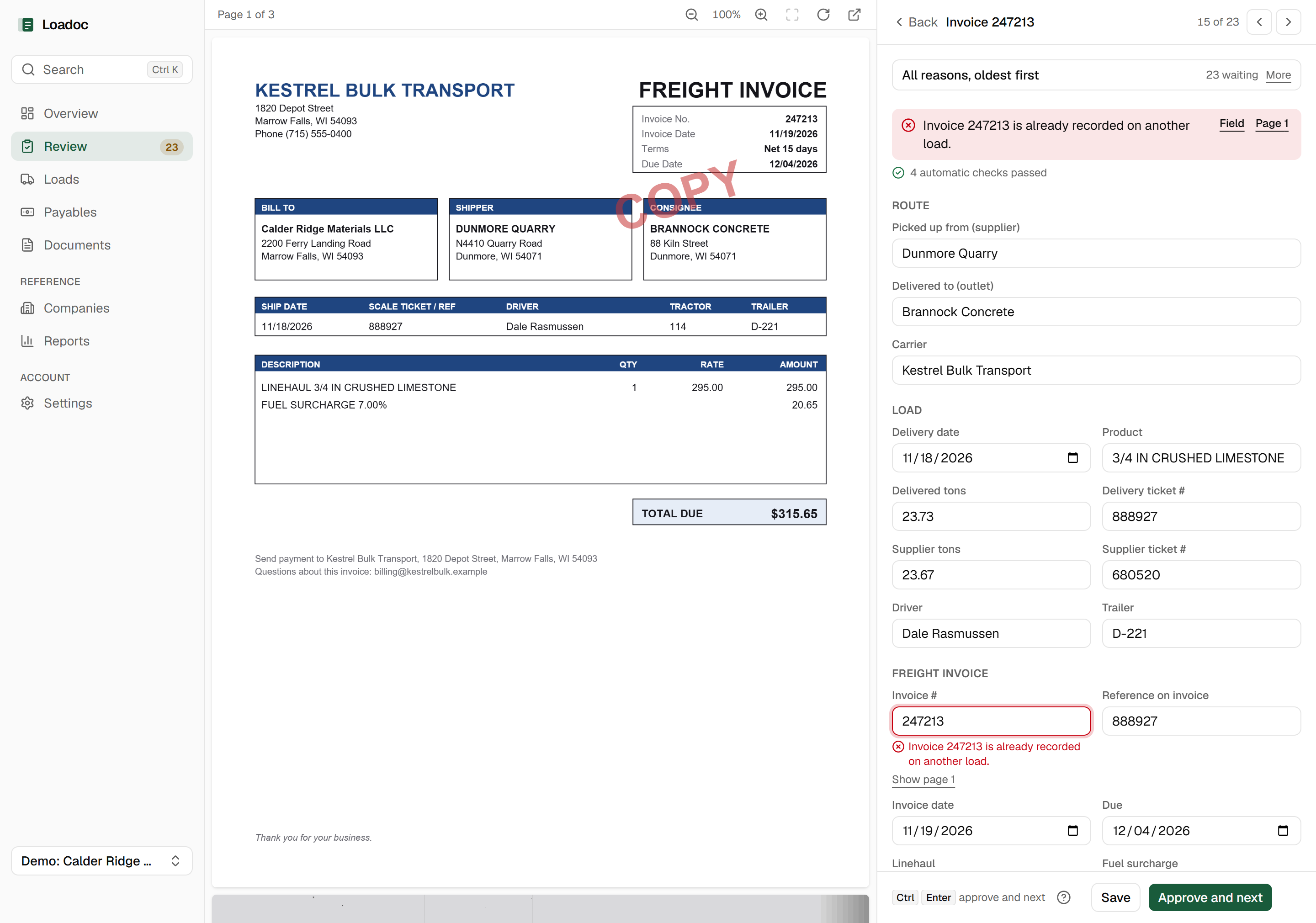
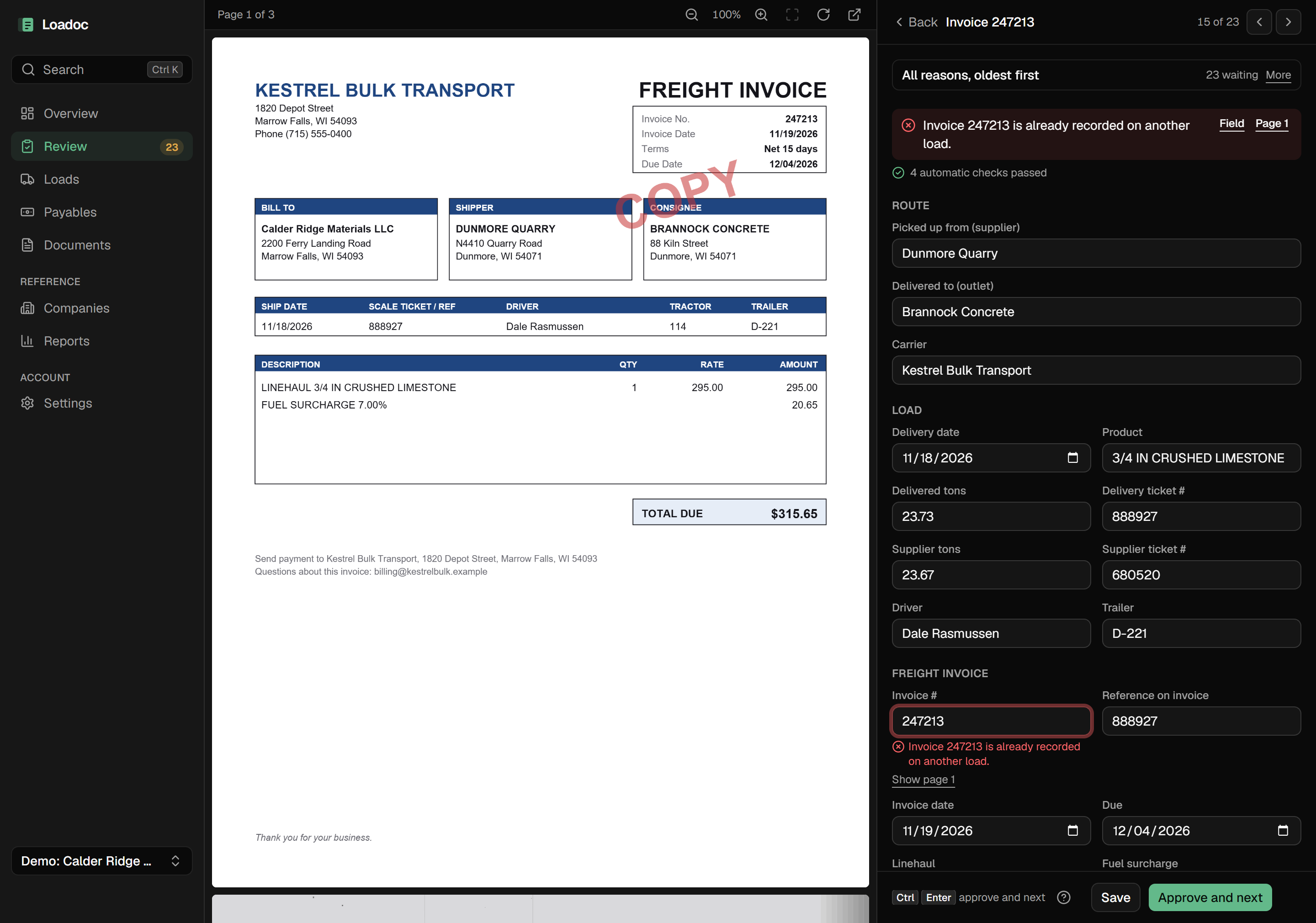
| The invoice is not already on fileInvoice numbers are compared ignoring case, spaces, dashes and leading zeros. | Flagged: Invoice 247213 is already recorded on another load. |
| Everything the invoice needs is thereInvoice number, ship date, shipper, consignee and amount due. | Flagged: No ship date found on the invoice. |
| A credit is not paid as a billCredit memos are kept with a negative amount and always shown to a person. | Flagged: This is a credit memo, not a bill. It takes money off an earlier invoice. |
The weight side of the audit, ticket numbers and scale weights, is on the scale ticket reconciliation page. For the full list to work through by hand, see the carrier invoice audit checklist.
Duplicates
Haulers resend. The second copy stops here.
A resent invoice looks exactly like one that has not been paid. In a spreadsheet the only defence is someone remembering the number.
Loadoc holds the second copy and names the invoice already on file. If both somehow reach the payables screen, the invoice is flagged there too: it is on two unpaid loads, pay it once.
Charges
When the lines and the total part company
Every amount involved is marked, because Loadoc cannot know which one the hauler got wrong. If the fields match the paper and it still does not add up, the bill is wrong. Do not pay it as it stands.
Detention, stand-by time and other extra charges are kept as their own figure, so a lane that is billed waiting time three loads in ten shows up in the reports.
New invoice layouts
A new hauler is watched until its invoices have earned it
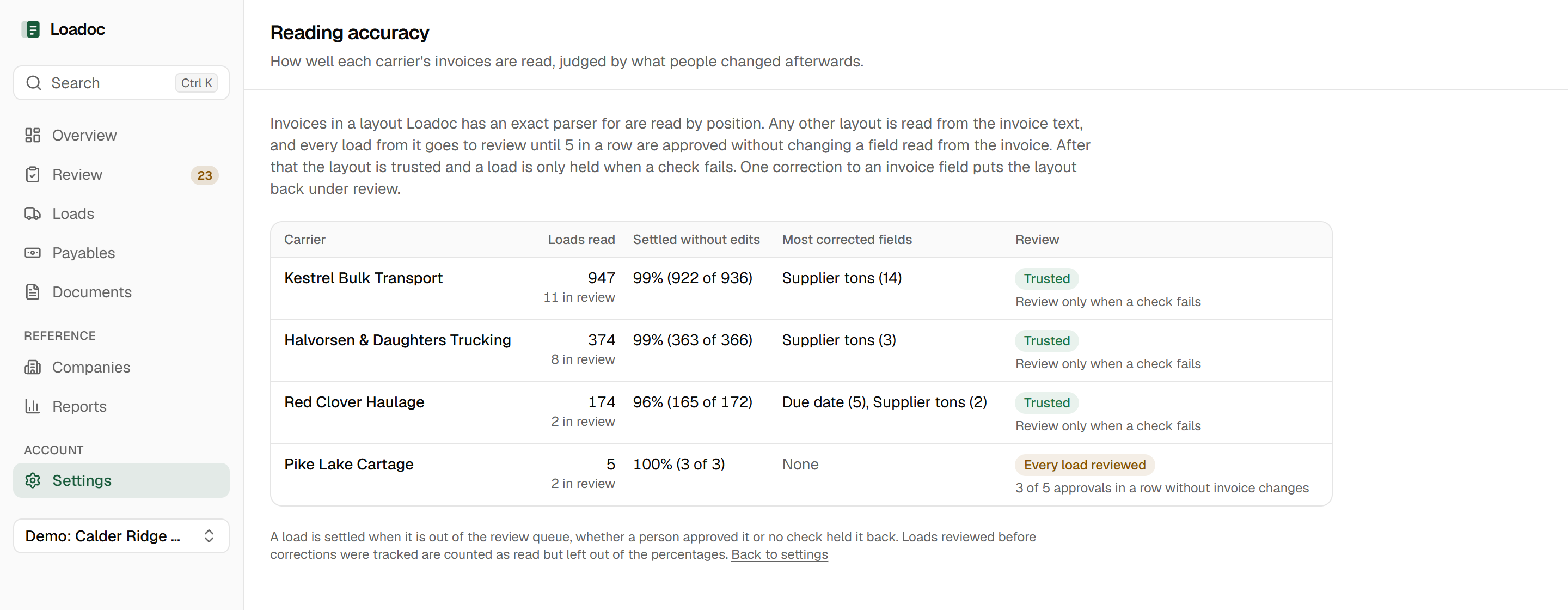
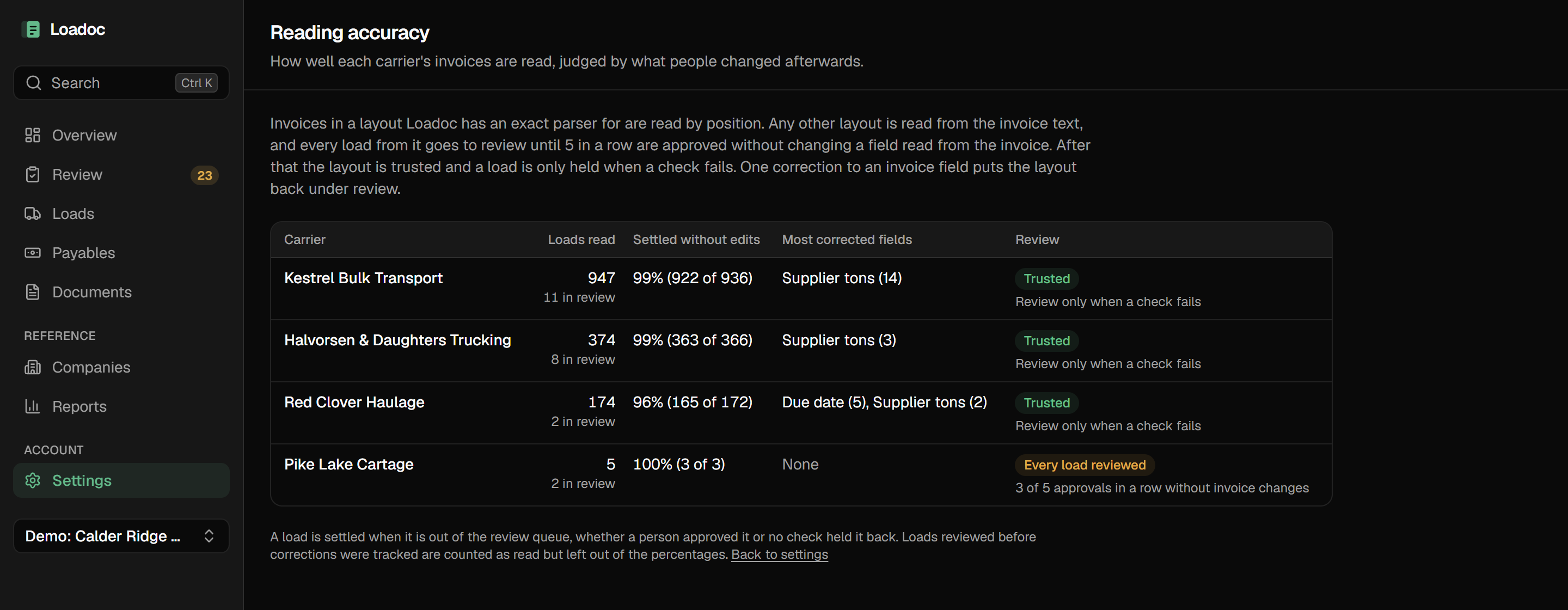
Loadoc keeps count of what people correct, by hauler and by field. It is the product's own record of how well it reads your paperwork, and it is on a screen you can open.
We do not quote an accuracy percentage. Yours is in Settings, from your own invoices.
What it does not do
It does not audit against contract rates, fuel tables or accessorial rules. It tells you when a lane is billed off its usual figure and when a total is above the rate confirmation in the PDF.
It does not file claims or dispute charges for you. It shows you what does not agree, with the document beside it.
It does not split one invoice into many loads. An invoice that covers several loads is read as one load with the summed total. Extra tickets and multi-stop deliveries are flagged for a person; a plain invoice for three loads with neither may not be.
Questions
- Is this the same as a freight audit and payment service?
- No. Freight audit firms check invoices against contract rates and tariffs across parcel, LTL, truckload and ocean, mostly for large shippers, and many of them pay the carrier for you. Loadoc checks each truckload invoice against its own paperwork and against what the lane is usually billed. It does not hold your rate tables and it does not pay anyone.
- Does it work for parcel or LTL?
- It is built for truckload invoices that come with scale tickets or a rate confirmation. It will read an LTL bill, but the checks that earn their keep are the ones on weight tickets and per-load rates.
- Every hauler's invoice looks different. Does that matter?
- A layout Loadoc has not seen before is read and always sent to review, so a person confirms the first ones. After five in a row from that layout are approved without changing a field, it is trusted, and a load is then only held when a check fails. One correction puts the layout back under review.
- How does it stop a duplicate from being paid?
- Twice. When a second copy of an invoice arrives it is held in review with the number already on file. Later, on the payables screen, an invoice number that appears on two unpaid loads, or one that has already been paid, raises a warning that has to be acknowledged before the payment can be recorded.
- How long do I have to dispute a freight bill?
- Under 49 U.S.C. 13710, a shipper has 180 days from receiving a motor carrier's bill to contest it. In practice it is far easier to hold an invoice than to get money back, which is the reason to check before paying.
- What does it read?
- PDF files up to 25 MB. Invoices printed by carrier software are read from the text in the PDF, and every figure reported is looked up in that text. Scanned pages are read from the image. Spreadsheets, loose photos and EDI are not read.
Guide: auditing by hand
The rest of the job
- Scale ticket reconciliationTicket numbers, gross, tare and net, and the supplier's weight against the delivered weight.
- Carrier payablesWhat you owe each hauler and when, the weekly payment, and the remittance that goes with it.
- Lane rates and freight costFreight per ton on every lane, and the day a hauler's rate moved.
Run last month's freight bills through it
Connect the inbox your haulers bill, or drop in the PDFs you already have. The first batch shows which loads pass and which get set aside, and why.
14 days, up to 400 loads. Already have an account? Sign in